


Optical payloads for mission success
Some explore the depths of our planet, while others look outward to the universe. Our mission is to equip both paths of discovery with advanced optical payloads that detect, identify and monitor new phenomena in space and on Earth.
To meet this wide range of applications, our systems are designed to operate across multiple spectral ranges, from UV and visible to near- and thermal infrared. Each payload is carefully engineered to match the mission’s data acquisition strategy, whether panchromatic, multispectral or hyperspectral, ensuring accuracy and reliability across diverse platforms such as satellites, aircraft, drones and high-altitude systems.
Our co-engineering approach brings us close to customers, refining mission parameters such as spatial resolution, coverage, and detectability. Together, we select the most suitable sensors and optical technologies to deliver payloads that make every mission a success.
Dive into our recent Earth observation missions

GESat Demonstrator
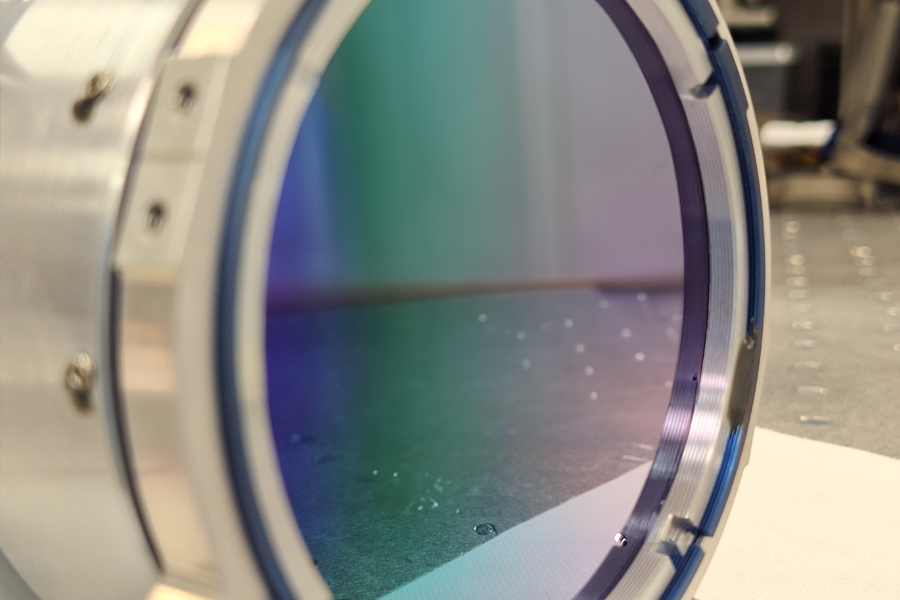
On January 14, 2025, a GESat Satellite, the CH4 monitoring demonstrator from French company Absolut Sensing, was successfully launched from Vandenberg Space Force Base aboard a SpaceX Falcon 9. GESat is Absolut Sensing’s constellation, designed to track all unseen atmospheric elements. Firstly, it focuses on greenhouse gas emissions to contribute to the global mission of reducing greenhouse gases and combating climate change. Lambda-X has been a proud partner in this mission, delivering a two-channel optical payload (SWIR and VIS). This unique instrument combines visible and SWIR imaging to achieve both high spatial resolution images and high spectral resolution measurements, all within a single, compact telescope.
Flylab/CatFly
FlyLab-1 is an Earth Observation mission led by the aeronautics, space and defense French Laboratory ONERA, aiming at collecting data both in the visible and LWIR spectral range. For the LWIR observations with a targeted resolution of about 90 m m/pixel at 550 km, ONERA used an uncooled megapixel thermal detection module and signed a collaboration agreement with Lambda-X for the design, manufacturing, alignment, assembly and test of the IR optics, integrated in the CATFly Optical Payload of the mission. Lambda-X has delivered all the optics models to ONERA and they are now integrated in the satellite. After the successful completion of qualification tests at the platform level, the launch is currently planned for 2026.
Learn about our latest Space exploration missions
The Martian Moons eXploration
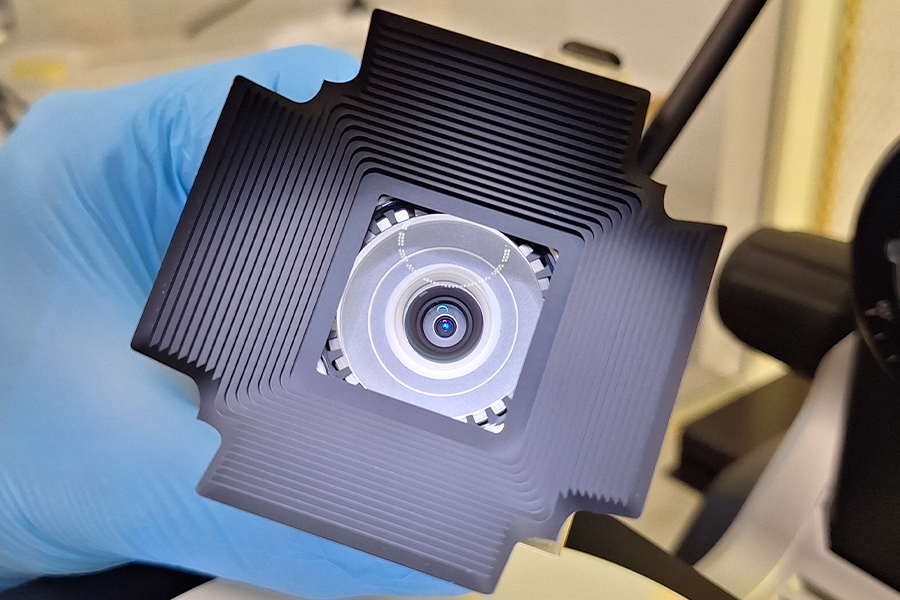
The Martian Moons eXploration (MMX) mission objective is to explore Mars’s moons Phobos and Deimos. This project is led by the Japan Aerospace Exploration Agency (JAXA) in collaboration with NASA, the French Space Agency CNES, the German Aerospace Center (DLR), and ESA. For this Mission, Lambda-X delivered to the French company 3D PLUS all the Qualification and Flight Models of the wide field of view (more than 80°) optics and performed the alignment and best focus adjustment of the lenses for integration in the IRIS Camera.
PROSPECT
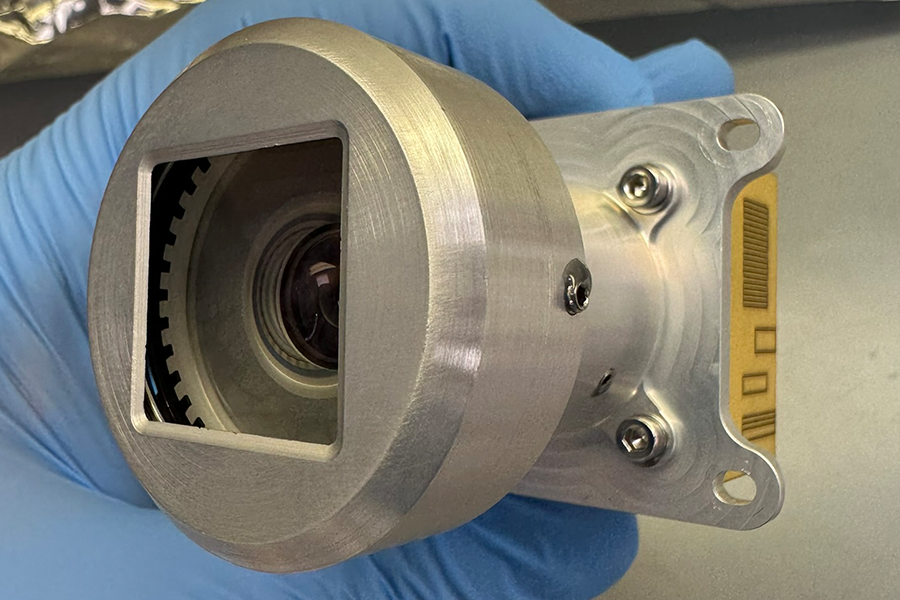
On the Moon’s south polar region PROSPECT (Package for Resource Observation and in-Situ Prospecting for Exploration, Commercial Exploitation, and Transportation)’s drill will operate to extract and analyze samples from the lunar terrain facing extreme challenges, including retrieving water, oxygen, and other valuable chemicals trapped at temperatures typically around -150 °C, dipping below -200 °C in certain areas. For this ESA program with Leonardo as prime contractor and in collaboration with our industrial partners (3D PLUS and Kayser Italia), Lambda-X is developing the camera unit optics for the ProSEED Sample Excavation and Extraction Drill’s Imaging System. This system must withstand extremely low storage temperatures and a dusty lunar environment.

Let’s turn your vision into mission-ready instruments!